
The drone industry in India is growing at an exceptional pace, creating powerful opportunities across multiple sectors. From agriculture and infrastructure to media and industrial inspection, drones are now an essential part of modern operations. A professional drone training course is the most reliable way to gain certified skills, legal authorization, and real-world confidence to succeed in this fast-moving field.
If you are serious about building a career as a drone pilot, this detailed guide will help you understand the value of structured training, DGCA certification, and industry-ready skills.
Call Us Any Time
+91-7678278885
+91-7678383160
+91-7678284091
+91-9971658735
+91-7703838253
Why a Professional Drone Training Course Is Important
Drones are no longer experimental technology. They are professional tools used daily by businesses, government agencies, and service providers. Without proper training and certification, commercial drone flying is illegal in India.
A certified drone training course helps you:
- Learn safe and legal drone operations
- Understand DGCA rules and airspace regulations
- Gain hands-on flying experience
- Build professional confidence
- Create long-term income opportunities
The right training gives you clarity, control, and career stability in an industry that continues to expand every year.
DGCA Approved Drone Pilot Training in India
In India, all commercial drone operations are regulated by the Directorate General of Civil Aviation (DGCA). To fly drones legally for business or professional use, you must complete training from a DGCA-approved Remote Pilot Training Organisation (RPTO).
After successful completion, you receive a Remote Pilot Certificate (RPC) issued through the DGCA Digital Sky platform. This certificate proves that you are trained, verified, and authorized to operate drones professionally within India.
What You Learn in a Drone Training Course
A structured drone training course focuses on both theoretical knowledge and practical flying skills.
Theory and Classroom Training
The classroom sessions build a strong foundation and include:
- Basics of drone technology and aerodynamics
- Indian airspace classification and regulations
- Flight safety procedures and emergency handling
- Weather understanding and its impact on drones
- Pre-flight planning and risk management
This knowledge ensures you are mentally prepared before actual flight training begins.
Simulator-Based Training
Modern drone courses use advanced flight simulators to improve learning accuracy and safety. Simulator training allows you to practice:
- Drone controls and orientation
- Emergency scenarios
- Complex maneuvers
- Mission planning
AI-assisted simulators provide performance feedback and help improve precision before real-world flying.
Practical Drone Flight Training
Hands-on training is the most valuable part of the course. Under expert instructor supervision, you will learn:
- Safe take-off and landing
- Hover control and directional movement
- Flight stability and altitude management
- Emergency response techniques
- Real mission execution
This practical exposure builds confidence and prepares you for professional assignments.
Assessment and Certification
After completing training:
- Your flight logs are submitted to the DGCA Digital Sky platform
- You undergo final evaluation as per DGCA standards
- On passing, your Remote Pilot Certificate is issued
This certification allows you to legally fly drones for commercial purposes across India.
Eligibility Criteria for Drone Training
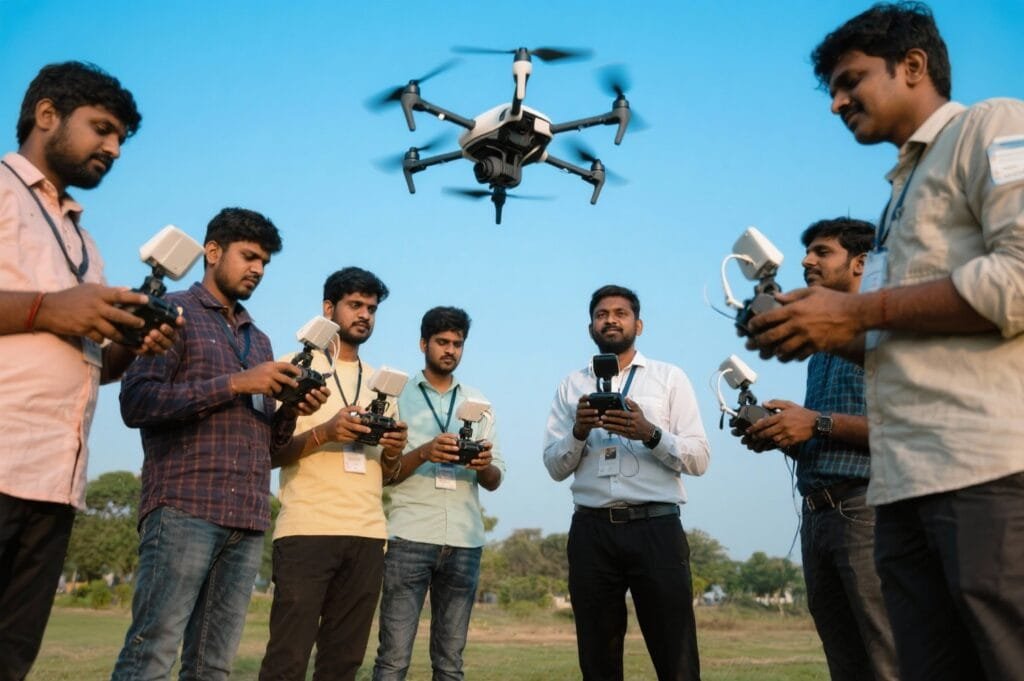
Drone training courses are open to beginners and professionals. Basic eligibility requirements include:
- Minimum age of 18 years
- Minimum 10th standard qualification
- Basic understanding of English
- Medical fitness for safe operation
No prior aviation or drone experience is required.
Career Opportunities After Drone Training
Certified drone pilots are in high demand across industries.
Aerial Photography and Videography
Professionals use drones for films, advertisements, real estate marketing, and digital media production.
Agriculture and Crop Monitoring
Drones are used for crop assessment, spraying, irrigation planning, and yield optimization.
Surveying and Mapping
Drone pilots assist in land surveys, 3D mapping, mining inspections, and urban planning.
Infrastructure and Construction
Drones help monitor construction progress, inspect structures, and enhance site safety.
Emergency and Disaster Management
Drones play a critical role in search, rescue, and damage assessment during emergencies.
With certification, you can work as a freelancer, join companies, or start your own drone service business.
Drone Training Course Duration
The duration of a drone training course depends on the category and specialization.
- Basic DGCA Remote Pilot Course: 5 to 7 days
- Intermediate operational training: 2 to 4 weeks
- Advanced commercial or industrial training: Customized programs
Most courses are designed to balance learning speed with skill mastery.
What Makes This Drone Training Program Reliable
A professional drone course should deliver more than a certificate. It should build trust, confidence, and long-term value.
This training program offers:
- DGCA-approved certification
- Experienced instructors
- Real drone flying practice
- Advanced simulator training
- Industry-focused curriculum
- Post-training guidance
Every module is designed to help you grow professionally and emotionally, with confidence in your abilities.
Location
Training Location
https://share.google/I9bAst3IOP68PxbyZ
How to Enroll in the Drone Training Course
Enrollment is simple and quick:
- Contact the training team using the numbers provided
- Share your eligibility details
- Complete the registration process
- Begin your certified drone pilot journey
Final Thoughts
Drone technology is shaping the future of multiple industries. With the right training, certification, and mindset, you can build a stable and rewarding career in this growing sector.
A professional drone training course is not just about learning to fly. It is about responsibility, precision, confidence, and professional growth. Start your journey today and take control of a future that is innovative, optimistic, and full of opportunity.